

By Tanuj Bansal
I often think a game is closer to a piece of music than a checklist.
The opening melody of a song can capture our attention before we fully
understand why. We do not stop to analyse every instrument or production
decision. Something in those first few moments simply makes us want to keep
listening.
I believe games build a similar connection with their players. The opening screen,
sound, visual presentation, first interaction, and response to an input all help set
the tone. They tell the player what kind of experience they have entered and
whether it feels worth exploring.
But a strong opening is only an invitation. If a song loses its rhythm, the listener
may gradually disconnect. A game can do the same through confusing feedback,
interrupted gameplay, inconsistent controls, technical instability, or small issues
that repeatedly pull the player out of the experience.
For me, protecting that journey from attention to trust is what quality is really
about.
Why quality matters to me
What makes me passionate about quality is not simply the satisfaction of finding
a defect. It is understanding how something that appears small from a technical
perspective can change the way a player sees the entire game.
When working in QA, it is easy to become focused on defect counts, severity
levels, test coverage, pass rates, and release blockers. These are necessary, but
they describe the team’s view of the build. The player sees none of them.
A game may be created through the combined work of designers, developers,
artists, animators, writers, sound designers, producers, mathematicians, and
quality teams. The player does not experience those contributions separately.
They experience one game.
They do not know which department created a feature, how difficult it was to
implement, or why an issue remained in the build. They only know what
happened when they played.
Over time, this has changed the way I look at testing. I still want to know whether
a feature works, but I also want to understand what the player receives when it
works.
Is the action clear? Does the response make sense? Can the player trust the
information being presented? Does the experience continue without unnecessary
interruption?
During one of my own device checks, a game interface appeared correct on a
foldable phone in its original screen state. After I unfolded the device and
changed its orientation, important information became misaligned.
The game did not crash. Its basic functionality remained available. In a defect
tracker, it could reasonably have been classified as a visual compatibility issue.
But I found myself looking at it from the player’s side. If important information
suddenly shifts or becomes difficult to interpret, the concern is no longer only
that the screen looks unpolished. The player may start questioning whether they
are reading the information correctly and whether the game can be trusted on
their device.
Not every visual issue damages trust. The context and information affected
matter. But this observation reinforced something I have come to believe
strongly:
That difference between technical classification and player impact is one of the
main reasons quality matters to me. I do not want testing to end with identifying
what is broken. I want it to help protect the experience the team intended to
create.
Can player experience be measured?
My honest answer is that it cannot be measured completely, but it can be
understood well enough to support better decisions.
Enjoyment is personal. Different players enjoy different genres, mechanics, art
styles, difficulty levels, and pacing. I do not believe one number can prove that a
game is fun or that every player will enjoy it.
What I can observe are the conditions that allow enjoyment to happen or prevent
the player from reaching it.
When I test a game, I pay attention to how long it takes to reach the first
meaningful interaction. I look at whether the next action is clear, whether
important feedback appears at the right moment, and whether the player can
understand why something happened.
I also look for hesitation points. Is the player likely to pause because the game is
asking them to think, or because it has not explained what to do? Are repeated
selections part of the intended challenge, or is the control unclear? If an
interruption occurs, can the player recover without losing progress or
confidence?
These distinctions matter because intended difficulty and unintended friction are
not the same thing.
A difficult level, puzzle, or opponent may be an essential part of the experience.
An unclear instruction, delayed response, broken layout, or poorly
communicated outcome is friction created by the product rather than the
intended challenge.
Loading interruptions, response times, navigation mistakes, repeated support
questions, device-specific behaviour, and points where players regularly leave
can all help identify where the experience needs closer attention.
I treat these observations as signals, not automatic conclusions.
If several players leave at the same point, there may be unnecessary friction.
There may also be an intentional increase in difficulty, a mismatch with the
audience, or something unrelated to the game. The behaviour tells us where to
investigate, but not always why it happened.
I also do not believe QA owns the complete player experience. Designers, user
researchers, analytics teams, community teams, support teams, and players
themselves can all provide perspectives that QA cannot produce alone.
What QA can contribute is a clear connection between product behaviour and
realistic player conditions. We can identify which device, state, sequence, or
interruption produces a problem and explain how it may affect a particular
moment in the player journey.
For me, player experience becomes measurable when we bring these
observations together rather than expecting one metric to explain everything.
How do I know when good is good?
I do not judge a game only by whether it launches, whether its main features
work, or whether it has a low number of open defects.
A build can pass its functional test cases and still feel confusing, inconsistent, or
unfinished. A test case can confirm that the system performed the action written
in the requirement. It does not always tell me whether the player understood that
action or whether it supported the experience the game promised.
Before deciding whether a game is good, I first try to understand what it is
attempting to be.
Is it supposed to feel fast and responsive? Strategic and thoughtful? Relaxing and
intuitive? Competitive and precise?
I then return to three questions.
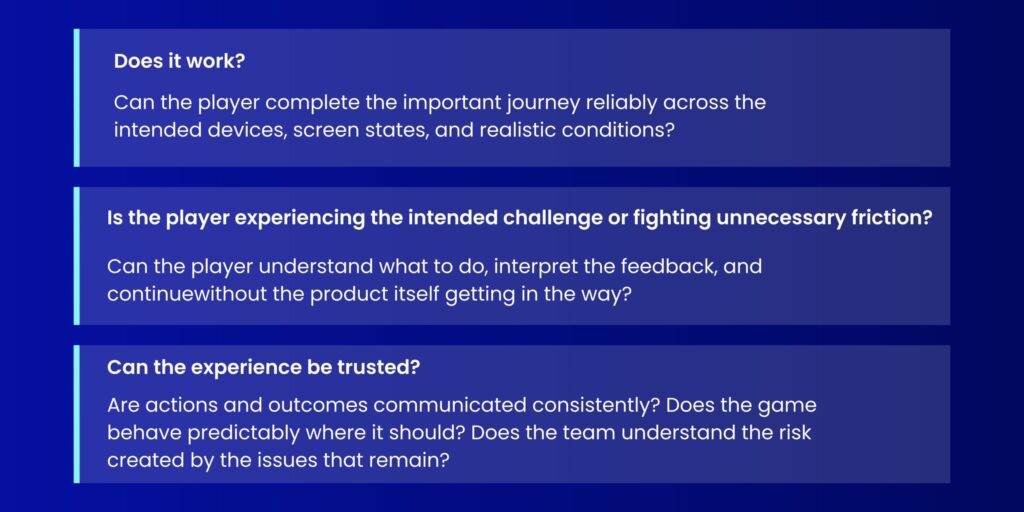
These questions are not a universal formula or a replacement for testing. They
help me keep the release discussion connected to both technical evidence and the
player’s experience.
I do not expect a game to be perfect before it can be considered good. Perfection
is rarely a realistic release condition. Every release involves decisions about time,
scope, priority, audience, and risk.
But “good enough” should be an informed decision. It should not simply mean
that the testing period has ended or that the release date has arrived.
The team should understand what remains unresolved, who may be affected,
which part of the player journey is exposed, and why the remaining risk is
acceptable.
What I believe QA should contribute
I do not see QA only as the final gate that approves or stops a release.
When I report an issue, I want to explain more than what happened. I want to
identify the conditions that caused it, the players or devices that may be affected,
the part of the journey it interrupts, and why the issue matters.
This is particularly important because technical severity and player impact are
connected, but they are not always equal.
A visual problem in a frequently viewed area can meaningfully affect the player’s
confidence. A serious technical failure hidden behind an uncommon sequence
may affect fewer players but still represent unacceptable risk. The severity label
helps organise the discussion, but it should not replace judgement.
Evidence is what makes that judgement credible. Reproducibility, affected
devices, relevant states, recovery options, and journey context help the team
understand the real consequence of an issue.
For me, QA is at its strongest when it connects product behaviour, player impact,
and release risk. The role is not simply to say that something is broken. It is to
help the team understand what that broken behaviour means for the person
playing the game.
Finding the rhythm
A game’s opening moments are like the opening melody of a song. They give the
audience a reason to pay attention. Everything that follows has to maintain that
connection.
When the controls, visuals, sound, design, and technical systems support one
another, players may never consciously think about quality. They simply become
part of the experience.
When those elements fall out of rhythm, players feel the interruption, even if
they cannot identify its technical cause.
Like music, not every game will be loved by every audience. Quality cannot
guarantee taste, popularity, or commercial success. What it can do is give the
game a fair opportunity to connect with the players it was created for.
For me, a game is good enough when its intended players can understand, trust,
and experience what the team created, and when the risk that remains is a
conscious decision rather than an unpleasant surprise.
Contributor bio
Tanuj Bansal is the Founder and CEO of Pioneer CertiLabs. His work focuses on
game and iGaming QA, compatibility, player journeys, product quality, and
release readiness.
For more updates, head to our news section!